Trunyan Village and coffee with d..y
January 15
I'm always groggy in the morning and need a few liters of coffee to get me going. There's always the economical version, like cheap hotel coffee, store-bought coffee, or the hotel breakfast. This time I decided to splurge and try some... crappy... coffee. I mean... Kopi Luwak, the most expensive coffee in the world. There are tons of coffee plantations in Bali, and many plantations of this particular coffee.
For the uninitiated, luwak is Indonesian for civet. A small, sweet, furry animal that feeds on coffee. Civets are picky and choose only the best beans. The civet digests the pulp, but not the seed; it is only slightly digested. The slightly fermented seed is then excreted. These seeds are collected, dried, and cleaned, and thus we obtain the most expensive coffee in the world. Civets roam the forest, so collecting these seeds is not easy at all. They are also small animals with small bellies, so they don't "produce" much coffee.
Plantations always offer free sample packs, where you can try various coffees and teas. Kopi luwak costs 50,000 IDR (about 15 PLN), and a small cup, of course. I usually drink coffee with milk, but I decided it would be a disgrace to the coffee and drank it black. The taste is indeed different from "regular," but was I blown away? Probably not, but I'm no coffee expert; I drink instant piss.


Awakened and energized, I continued my journey. There was another temple ahead of me, Ulun Danu Beratan. I was getting a bit tired of visiting temples, but I decided to give it a try anyway. On the way, I saw another market; I love markets, so I decided to waste some time there. I met a very witty Balinese woman there. When I asked her, "How much are pitayas?" (also known as dragon fruit), she replied, "IDR 120,000 (PLN 35!)." I know I usually (or always?) pay more than the locals, but let's not exaggerate. I told her I buy pitayas for 15,000, and that's what I'm willing to pay. The woman didn't give up, okay, around 60,000. I said to the woman: if I buy them for 15,000, why should I buy them from you for 60,000? She didn't give up, I said 15,000, she said 50,000, I still said 15,000, she said 40,000 :), finally I paid 15,000. For them it's still a fair price, and I'm not fooled.
The market was small but very nice, and I'd gladly return there if I ever visit Bali again. You could buy spices, teas, coffees (including kopi luwak, but I have my doubts about its authenticity and quality), clothes, handicrafts, fruit, and vegetables. You could get a really good price, and importantly, the sellers weren't pushy. They invited you to explore their stalls but weren't pushy, not forcing you to buy anything. In such conditions, I can shop; excessive intrusion has the opposite effect on me, so I run away as quickly as possible.
Richer by a few stuffed shopping bags, I finally set off towards the temple that was just around the corner.


I arrived before noon temple Ulun Danu Beratan, which was built in the 12th century, on Lake Beratan. It is located at an altitude of about 800 meters above sea level. The air was fresh and crisp, the sun shone brighter, and the sky was bluer. The views were truly magnificent. I'm glad I didn't miss this temple; it's probably one of the most beautiful I've ever visited.


The last but most important stage of today's journey was Trunyan Village. It's a place avoided by tourists and has a bad reputation, which made it all the more tempting for me. It's the second and last place in Bali where the indigenous Balinese, the Bali Aga, live. In previous posts, I've written about Tenganan village, where the Bali Aga also live, but they are open to tourists, friendly, and welcoming.
Trunyan Village lies on Lake Batur, at the foot of Mount Abang. Getting there is quite difficult, but we were lucky, and at the lake's viewing terraces, we met a villager who agreed to guide us. Of course, he didn't do it out of the goodness of his heart; he knew I wanted to go to the cemetery, and that comes at a steep price. He was riding a scooter, which outnumbers mosquitoes in Bali, and we followed in a car. The path was narrow and winding, sometimes leading steeply uphill, sometimes steeply downhill. My driver kept his hand on the horn the entire time, alerting potential vehicles traveling in the opposite direction to our presence.
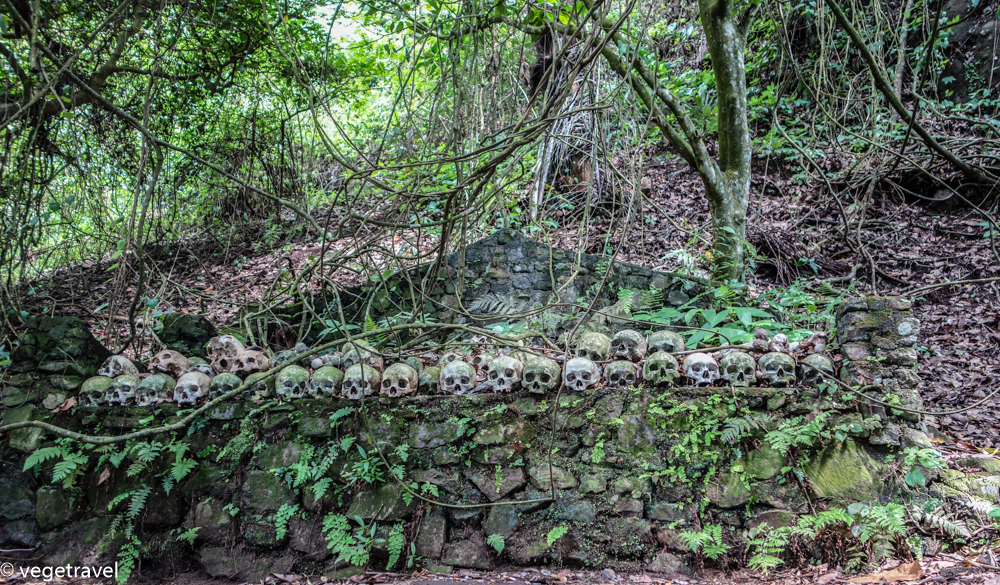
I mentioned the cemetery, yes, I went there to see the cemetery, but not an ordinary, traditional cemetery. The Balinese cremate bodies after death (I described Ngaben in another post), but the inhabitants of Trunian Village are the only ones who do not cremate bodies. They have two methods of burial: in the ground. This method is used to bury people who had wounds on their bodies, were disabled, did not die "of old age," children who still had baby teeth, suicides, or murdered people. The second method is mepasah. The bodies are carried to the cemetery and left under the Taru Menyan tree. This rare tree has special properties. Taru means tree, and menyan means pleasant smell. The tree is said to mask the smell of decomposing flesh. Only a bamboo "scaffold" protects the bodies, intended to prevent them from being eaten by wild animals. Once the bodies are fully decomposed, the skulls are moved a short distance away and added to the collection.
You can't walk to the cemetery; you have to take a boat from the village. I've heard many stories about how, despite a pre-arranged fare, fishermen stop halfway and charge twice as much for the ride. Even that didn't deter me. The price surprised me a bit: IDR 650,000, luckily not per person, but per boat. Before we started our descent, our "pilot" told me that a small group of people had arrived a while ago and I could go with them and share the cost. There were people, but it turned out they didn't like the price and were still debating. I decided to wait, but it didn't look like they'd make up their minds anytime soon. Besides, I don't understand how people could think so much. While they were deliberating, the locals approached me and said that if they didn't decide, they could give me a small discount and go for IDR 500,000. It wasn't bad, I was paying my driver less for 10 hours of driving a day... but whatever, that's what I came here for, so I decided to pay. The group finally left after they'd been thinking about it for over an hour :) My wonderful driver offered to go with me. He was even afraid of these people, so he didn't want to let me go alone, and they didn't speak any English. It turned out there was nothing to be afraid of. The cruise lasted about 15 minutes. The men were even kind enough to tell me a little about the cemetery. When I reached the skulls, they told me not to be shy and take pictures. I shyly stood near the skulls, and the men said, "Take a skull, no problem." Thank you, I didn't take advantage of it; it was too much, even for me.
On the way back, the gentlemen asked my driver to tell me that a tip would be appreciated if I wanted one. Let's be honest, they didn't overexert themselves; it was a total of 30 minutes of paddling. I'd already paid a lot, so I decided not to give them more. I didn't reveal my intentions, though; I didn't want to tempt fate. Luckily, I reached shore and was given permission to walk around the village. I couldn't just enter the temple because I was in the cemetery and considered "unclean." People stared with interest, an old woman held out her hands for money, and some followed us, but that was it; no one was aggressive or pushy. I think all the scary stories about Trunyan are greatly exaggerated. It may not be the friendliest place in Bali, but there's really nothing to be afraid of.