Besakih's mother and the unplanned Ngaben
January 14th
The plan for January 14th changed several times. The original plan was to wake up very early and head to the temple. Pura Lempuyang. I'd read that it's best to arrive around 7 a.m., as there are 1,700 steps to climb. In an air-conditioned building, this isn't an easy task, so imagine climbing in the intense sun and blistering heat. We'd already visited several temples, with several more important ones still to come, so we started wondering if it was worth going to this one as well. My knee isn't in the best shape, so walking up so many stairs could make me sick. Besides, the ascent alone takes about three hours (according to one guide, even five!) and the descent about two. That's half a day. Our driver said we wouldn't lose much if we skipped it. The decision was made.
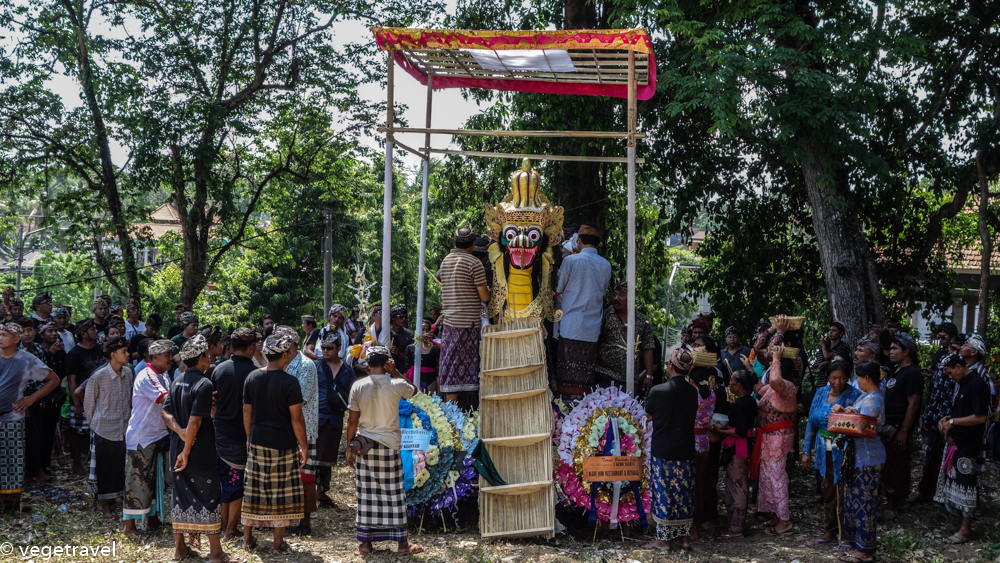
I decided to go to Pura Besakih The Mother of Temples, the most important temple in Bali. We left after 9:00 AM and had about 45 km to cover, which in Bali translates to a minimum of 1.5 hours of driving. After about half an hour, passing through one of the many villages, I noticed a traditional sedan chair. This signaled Ngaben! This is a cremation ceremony, which I wanted to see, but the dates aren't usually listed at tourist information. Of course, I wanted to stay and see it. The problem was that the ceremony was supposed to start at 12:30 PM, and it wasn't even 10:00 AM. After a quick discussion with the driver, we decided to rush to Besakih, see what we had to see, and then rush back. The planned Trunyan Village would have to wait until the next day.
Already during the drive, it became clear that our plan was overly optimistic, as we still had a long way to go. The narrow roads wouldn't allow for much speed, making it difficult to keep up. I'd almost gotten used to the idea of missing Ngaben, but our driver was determined to keep his client happy. He accelerated, and I was glad I had seat belts. It was already certain we wouldn't be able to turn around by 12:30, but the driver said we'd make it just in time for the cremation, missing the body through town.
In total, the drive to Mother Besakih took us about two hours. At least in the car, I had time to refresh my knowledge about the temple, or rather, the temple complex. It consists of 22 individual temples, which began to be built in the 14th century and were later added to. Its location is truly picturesque, lying at the foot of the sacred Mount Agung (or rather, volcano), at an altitude of about 1,000 meters above sea level. In 1963, the volcano erupted, claiming many lives and causing much destruction, but leaving Mother Besakih virtually undamaged. This reinforced the Balinese belief that it was a sacred site, and therefore, it was spared the volcano.
Despite its beauty and uniqueness, it's not a particularly touristy place, perhaps because of the sheer number of scams and the perceived inhospitability of outsiders. I found this information in a guidebook, so I was extra cautious from the moment I stepped out of the car. As it turned out, I was rightly so.
The first step was buying tickets, a simple affair. I wasn't expecting any surprises here, but then a rather unfriendly man told us to sign a book, which, in addition to our name and country, also included a place for a "donation," which they were determined to collect. It took me a few minutes to argue that I wanted to buy a ticket, period. Our driver, who generally didn't want to get involved in such situations, helped us. I understood him; I'd leave, he'd stay and take other customers to the place, so I didn't want any unpleasantness. I got my ticket, but they tried to rip me off again. The man said that despite my long skirt, I needed a sarong, which he would then tie for me. Okay, I just bought a ticket; in all the previous temples, sarongs were loaned free of charge. He tied it for me. I was just starting to walk away when he started calling after me, "One dollar." I took off my sarong and almost threw it at him; I really don't like being pulled over. It turned out, of course, that I didn't even need a sarong!
Well, I had a moment to calm down. From the parking lot, you have to walk uphill a bit, quite a long way, especially if you're in a hurry. There are scooters offering rides, for a fee, of course, but I preferred to walk rather than deal with the scammers again.
At the next entrance, we were greeted by a very nice gentleman who asked for our tickets. We showed him, and instead of giving them back, he started talking about the need for a guide, that he could show us around, etc. That's when we realized the gentleman didn't even work there and wasn't checking tickets. Another spike in blood pressure; I knew there would be a lot of them that day.
We continued on our way to the temple, and once we reached it, the vultures approached us again, trying to convince us we needed a guide. They showed us a sign that admission was only for Hindus. I'd read about that too, and indeed, there was a sign. Not every temple was accessible, and we respected that, of course, but we had the right to stay within the complex. It turned out I'd underestimated my opponent. Another guy approached us, this time very friendly, and said yes, we could move around the temple grounds, just not everywhere. He pointed out the direction we should go. We thanked him and started heading in that direction. Then the same guy called out to us, saying we couldn't go there, that we had to go around. So we started going a different way, and he called out to us again, saying we were going the wrong way. This happened several times until we realized he was deliberately misleading us and wanted us to feel lost and in need of a guide! We almost succeeded. Out of curiosity, we asked how much the dubious pleasure of being guided by such a pleasant fellow would cost. 70,000 IDR. We didn't pay, we went sightseeing on our own, this time ignoring him, but before leaving, I couldn't resist commenting. I said I was shocked and surprised. The Balinese consider themselves very religious, the Besakih Temple is the most important temple in Bali, how could they have the audacity and conscience to lie and rip people off in this sacred place. He muttered something about guarding these holy places from infidels, but we both knew that this had nothing to do with faith and were simply con artists.
After all this hassle, there was very little time left for sightseeing. We took a quick look at the temples and, quite without regret, moved on.


We didn't have the best time; I already knew we wouldn't be able to see the entire ceremony, but I was hoping for at least a fragment. The trip back also took longer than planned, reaching the village around 2:00 p.m., an hour and a half after the ceremony was scheduled to begin. The body had already been removed, but our driver had learned where it would be cremated. We made it in a flash. The Balinese don't mind tourists attending ceremonies, but just in case, we asked if we could stay. We were given permission to both attend and take photos.
A few more words about ngaben. As I mentioned, it's a ceremony of cremation and the transfer of the deceased to the next life. Interestingly, cremation isn't always performed on a "fresh" body. It's a very expensive event, and sometimes the family has to save up for it for several years. During this time, the body is buried, and once the family has the funds, it's unearthed and prepared for ngaben. The date of the ceremony is not random; the Balinese always consult with a priest, who selects the appropriate day. On the day of the ceremony, the body is placed in a coffin, which is then placed in a special sarcophagus resembling a buffalo (Lembu) or a temple (Wadah), made of wood and paper. The prepared body is then carried to the cremation site. The procession goes through the entire village, taking neither the straightest nor the shortest route, winding between streets to confuse and evade evil spirits. Unfortunately, I missed this stage, but I made it to the next part. When I arrived, the body was still "whole," and preparations for the cremation were still underway. I sat down with the rest of the "audience"—the villagers, family, and friends of the deceased—and waited for the climax. The family was still saying their goodbyes, and the priest and "staff" appeared. They inserted a huge metal rod, which I assumed would breathe fire and aid in the burning. After a few minutes, it began. The body was set on fire, a strange sensation, even stranger when the smoke from the corpse began to blow over us. No one was impressed; it's normal for the Balinese. After 20 minutes, people began to disperse; only immediate family remained. I didn't wait any longer; I had had enough excitement. I was curious, however, what would happen next, what they would do with what was left. My reliable driver explained: the ashes are collected in a box and transported to the ocean. There, they scatter them and release them to nature. He also told me that in the past they only used wood and the ceremony took a very long time, but now they use these metal flamethrowers, which speed up the process a lot.


The day culminated with a trip to the market to buy fruit. I was surprised by the prices of fruit in Asia, not only in Indonesia but also earlier in Malaysia. They're more expensive than in Poland! And I have to say, they don't taste all that great. Admittedly, it wasn't fruit season, but still...


I can't wait for the next day, and I'm also feeling a little anxious. I'm going to explore the least touristy place in Bali!